Boeing tests MQ-28 Ghost Bat's stealth characteristics
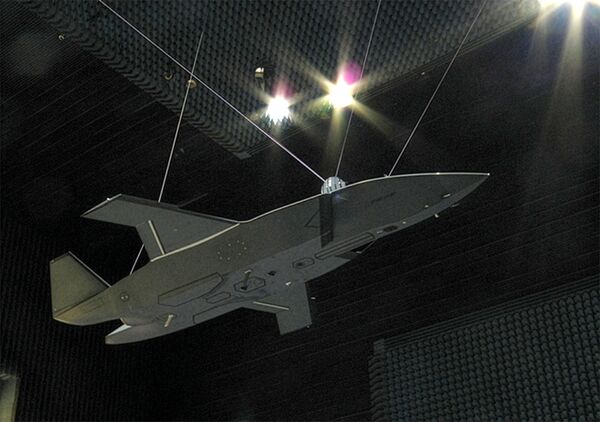

Boeing conducts radar cross section (RCS) testing of the MQ-28 Ghost Bat. (Boeing)
Boeing has announced that it has validated the stealth performance of the MQ-28 ‘Ghost Bat' collaborative combat aircraft (CCA) through radar cross section (RCS) testing.
The RCS testing “confirms the effectiveness of the MQ-28's design, production, and material choices in minimising radar detection,” Boeing said on 2 June.
While Boeing did not provide details of the tests, the company said the Ghost Bat's RCS reduces the range at which adversary radars can “detect and engage an MQ-28… enhancing the platform's survivability in contested environments”.
The testing was conducted to “provide customers with objective, repeatable data about survivability and detection risks,” Boeing added.
A Boeing photograph shows the Ghost Bat prototype suspended on overhead cables in an anechoic chamber during the testing. This setup likely enables the collection of RCS data across multiple aspect angles and orientations.
The data collected during the test “validates designs and models, supports procurement and certification, and guides tactics and countermeasure choices”, Boeing said.
Ensuring the Ghost Bat's stealth capabilities is a core programme requirement. According to the company, the MQ-28 is designed to support manned aircraft by performing roles that include surveillance, electronic warfare (EW), and force multiplication, “while maintaining a low radar profile”.
Development of the MQ-28 began in 2017, with the platform conducting its first flight in 2021. The Ghost Bat has completed more than 150 flights to date, Boeing said, adding that it is conducting “daily flight operations during test blocks” while “progressing airborne teaming with multiple MQ-28 aircraft”.
Go beyond the headlines - with direct links to interconnected entities
Get full access to validated equipment, military capabilities, and market insights.