B-21 flight test displays split control surface design
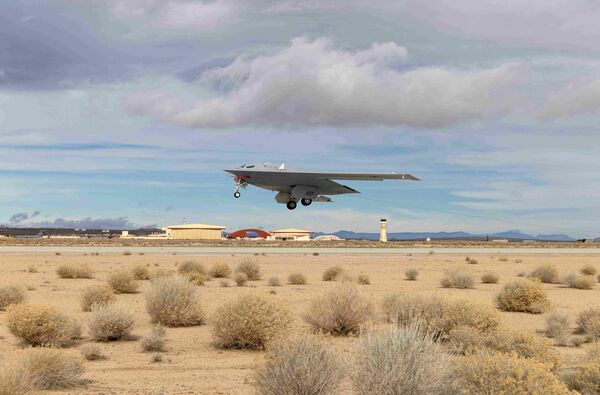

A B-21 Raider conducts flight tests, which includes ground testing, taxiing and flying operations, at Edwards Air Force Base, California, in June 2026. (US Air Force)
Recent photographs of the Northrop Grumman B-21 Raider's trailing-edge control surfaces displayed a unique surface deflection, for what appears to be for yaw, roll, or drag control.
During a 3 June test flight at Edwards Air Force Base in California where an operational test pilot, alongside a developmental test pilot, flew the bomber, a B-21 on approach displayed deflection of the inboard and outboard control surfaces to opposite sides.
The surface closer to the wing root and fuselage appeared deflected downward, while the outer surface appeared deflected upward.
When asked about the arrangement of the B-21's control surfaces, the US Air Force declined to comment “due to operational security”.
The Northrop Grumman B-2 Spirit's design, as well as similar platforms like China's Chengdu three-engined prototype (often referred to unofficially as the J-36) that lack a vertical tail or rudder for yaw control, has its control surfaces split into two halves, which function when deployed partially to control both yaw and roll of the aircraft.
These aircraft use split control surfaces as airbrakes on the outboard sections for providing drag at each wingtip, which can be manipulated through a flight control computer, for directional control. The flight computer analyses the flight conditions and controls the deflection of the left and right split surfaces to change the drag on either wingtip, to maintain direction, according to a Northrop Grumman technical paper.
While this arrangement maintains control of tail-less aircraft, it does so at the cost of increased drag in all conditions of flight.
Go beyond the headlines - with direct links to interconnected entities
Get full access to validated equipment, military capabilities, and market insights.