Australia announces initial operational capability for LRASM, JASSM-ER
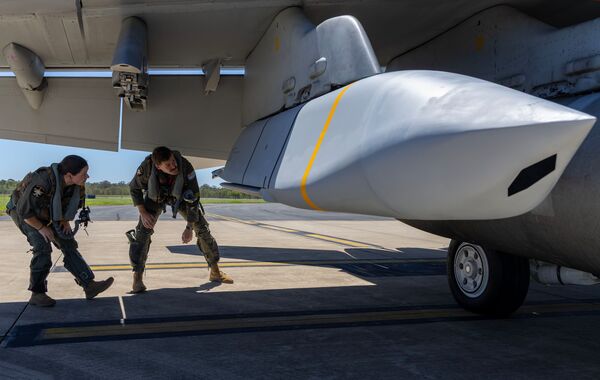

Personnel from the Royal Australian Air Force's No 1 Squadron conduct a pre-flight check of a JASSM-ER loaded on a F/A-18F Super Hornet at RAAF Base Amberley, in November 2025. (Commonwealth of Australia)
The Royal Australian Air Force (RAAF) has achieved initial operational capability (IOC) for its AGM-158C Long Range Anti-Ship Missile (LRASM) and AGM-158B Joint Air-to-Surface Stand-off Missile – Extended Range (JASSM-ER), the Australian Department of Defence (DoD) said.
Australia announced an AUD895.5 million (USD639 million) acquisition of LRASMs in 2020 and declared its intent to acquire the JASSM-ER in 2021. The DoD announced IOC for both missile types on 11 September 2026.
According to the DoD, the precision-guided, semi-autonomous LRASM is designed to destroy high-value maritime targets at ranges in excess of 370 km, while the JASSM-ER is intended to locate, identify, and strike land targets at ranges of up to 900 km.
The LRASM has been integrated with the RAAF's fleet of Boeing F/A-18F Super Hornet fighters and P-8A Poseidon maritime patrol aircraft, while the F/A-18F is also capable of operating JASSM-ERs, according to the DoD.
Increasing lethality
According to Chief of Air Force Air Marshal Stephen Chappell, the RAAF “has demonstrated it is ready to conduct long-range, survivable and lethal maritime and land strike, from [Boeing] F/A-18F Super Hornet aircraft, against highly defended targets”.
He said the acquisition of long-range maritime and land-strike missiles “will increase the lethality” of the RAAF's combat aircraft while enabling them to operate against increasingly sophisticated air-defence systems.
The capability will also strengthen the RAAF's deterrence posture by “holding potential adversary forces and infrastructure at risk from a greater distance” and support the service's role within the integrated, focused force, AM Chappell said.
Go beyond the headlines - with direct links to interconnected entities
Get full access to validated equipment, military capabilities, and market insights.