USSF, Boeing reach deal on MUOS SLE programme
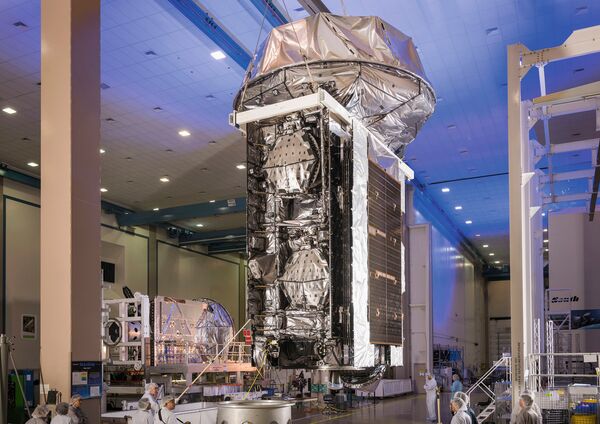

MUOS 4 preparing to ship from Lockheed Martin's Sunnyvale, California satellite manufacturing facility (Lockheed Martin)
US Space Force (USSF) and Boeing have reached a USD2 billion development and procurement deal to support the space service's life extension programme for the Mobile User Objective System (MUOS) satellite communications (satcom) constellation.
Under the terms of the deal, announced on 24 June, Boeing will design and build the two space vehicles (SVs) for the second phase of the MUOS Service Life Extension (MUOS SLE) programme, according to a USSF statement.
“The contract encompasses development, delivery, system integration and on-orbit test support of the two new space vehicles”, building upon SV and payload development work carried out under previous MUOS SLE phases, the statement said. Under the contract, the anticipated launch windows for the two new MUOS SLE SVs, dubbed SV 6 and SV 7, are slated for no later than 2031 and 2032 respectively, according to the statement.
Once on orbit, “these new space vehicles will directly support warfighters by extending the MUOS constellation's operational lifespan to 2035, the statement added. The MUOS SLE initiative is being led by Narrowband SATCOM Division of USSF's Space Systems Command's System Delta 88, according to the 24 June statement.
MUOS is an information technology (IT)-based 3G satellite communications (satcom) protocol initially designed to replace legacy ultrahigh-frequency (UHF) follow-on satcom constellations as a way to close capability gaps in space-based tactical communications stemming from the UHF capability.
Go beyond the headlines - with direct links to interconnected entities
Get full access to validated equipment, military capabilities, and market insights.