Ukraine conflict: Analysing UAV attacks targeting Moscow
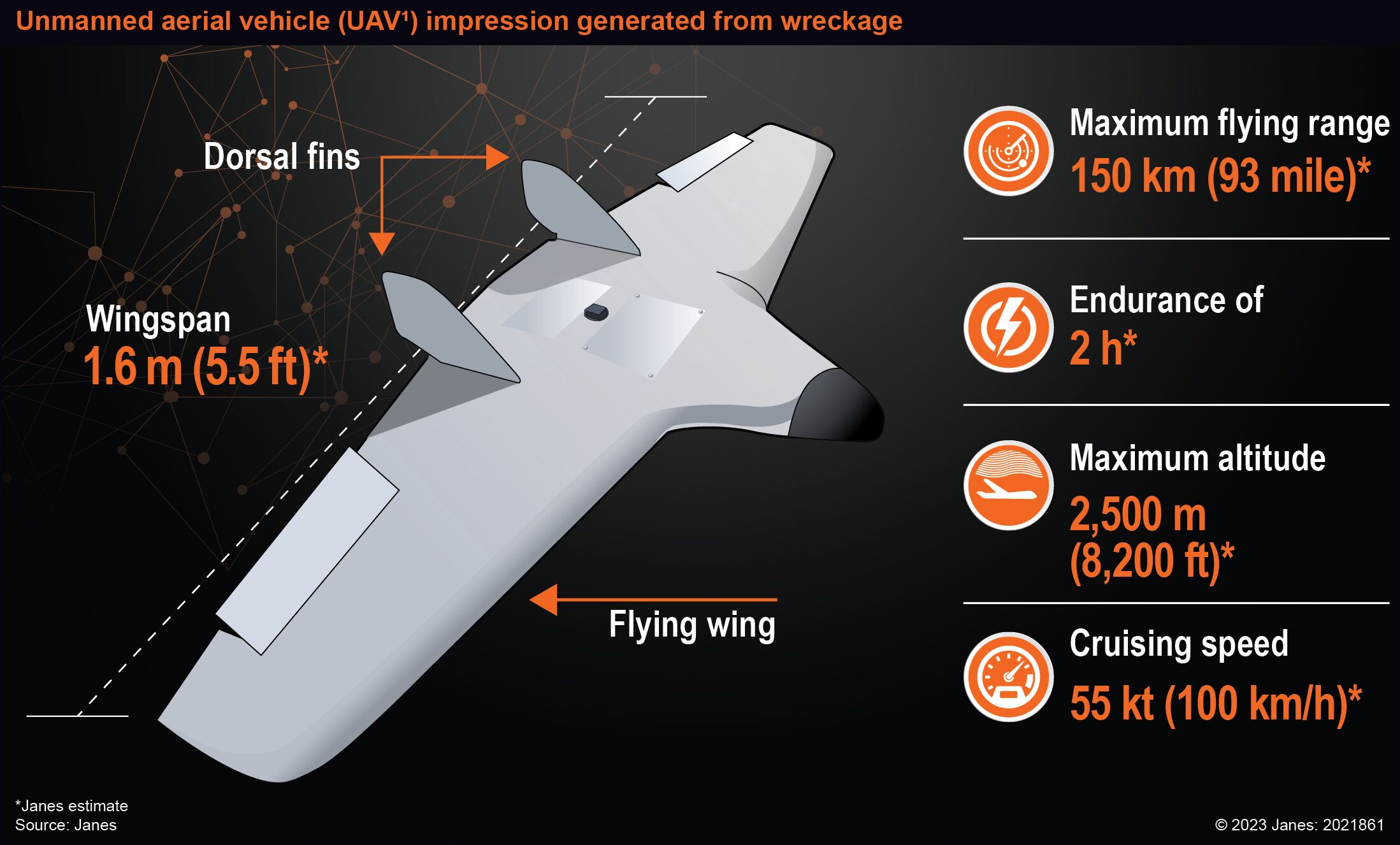

The unmanned aerial vehicle (UAV¹) used in recent attacks on complexes in Moscow. (Janes)
During the early hours of 30 May Moscow was attacked using multiple unmanned aerial vehicles (UAVs). The Ministry of Defence (MoD) of the Russian Federation has claimed that “the Kyiv regime launched a terrorist attack with UAVs on objects in Moscow”.
The MoD claims that multiple types of UAVs were used in a series of attacks. Images posted online indicate that there is one type of UAV (UAV1) that struck residential complexes or apartments.
According to the imagery, the UAV1 wreckage suggests that the aircraft belongs to the mini category (Janes classification of UAVs weighing between 2 and 20 kg). The UAV1 features a flying wing configuration, attached with dorsal fins on either side of the fuselage centre module rather than a conventional empennage. Imagery also indicates that the UAVs are mostly propelled by an electric or a rotary engine.
According to Janes analysis, the UAV1 has an estimated wingspan of about 1.6 m (5.5 ft), a maximum flying range of 150 km (93 mile), an endurance of two hours, a maximum altitude of less than 8,200 ft (2,500 m), and a cruising speed of 55 kt (100 km/h). Such UAVs could be programmed with automatic or semi-automatic en route flight programming or corrections, given the co-ordinates, and often can be operated on an inertial navigation system/Global Positioning System (GPS) or GLONASS.
Considering the maximum range of the UAV and the catapult ground launch capability, Janes understands that the UAVs were deployed from within Russia.
Go beyond the headlines - with direct links to interconnected entities
Get full access to validated equipment, military capabilities, and market insights.