Russia deploys Nabat V3 UAV detectors to mobile fire groups in Crimea
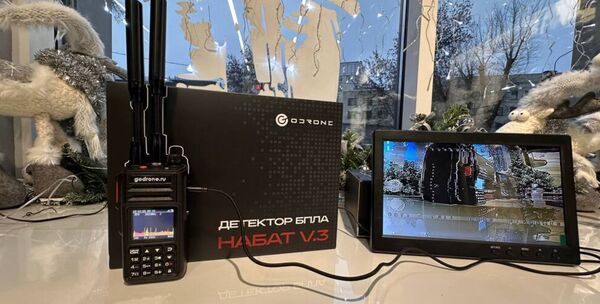

Russian company Godrone's Nabat V3 UAV detection system. (Godrone)
An undisclosed number of Russia's Nabat V3 unmanned aerial vehicle (UAV) detection systems have been deployed with more than 50 mobile fire groups (Mobil'nyye Ognevye Grupy: MOG) based in Crimea, Russian state news agency Tass reported on 28 August 2026.
Nabat V3 UAV detection systems are also in use on vessels operating in the Crimean region, according to a representative of Russia's Centre for Unmanned Systems and Technologies (Tsentr Bespilotnykh Sistem i Tekhnologiy: CBST) cited in the Tass report.
The Nabat V3 UAV detection system will be used to track unmanned systems flying at an altitude of up to 100 m, which CBST described in the article as “the dead zone”. “The adversary [Ukrainian forces] exploits this ‘dead zone' by launching small UAVs and mothership drones that deploy FPV [first person view] UAVs,” the CBST representative was quoted as saying.
The Nabat V3 can detect and identify up to seven UAVs simultaneously and has a detection range of up to 2 km for UAVs and unmanned surface vehicles (USVs), according to manufacturer Godrone's website. The system is advertised as operating across an ultra-wideband frequency range of 200-8800 MHz. The V3 variant has a video-interception function that the company says enables it to detect radio frequency (RF) signals from video transmitters. The system intercepts the video stream, which is then displayed in real time. According to Godrone the Nabat V2 did not have this capability.
The CBST representative was further quoted in the Tass report as saying that Nabat V3 can detect targets using digital or analogue communications at ranges of more than 11 km. This would represent a significant increase over the 2 km detection range listed on the manufacturer's website.
Go beyond the headlines - with direct links to interconnected entities
Get full access to validated equipment, military capabilities, and market insights.