BOMA 2026: Stark plans to integrate Vanta-6 with Ukrainian interceptor UAVs
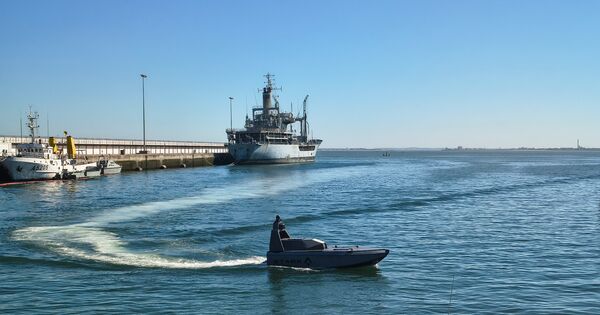

Stark's Vanta-6 USV seen during NATO's SOF exercise BOMA 2026 at the Lisbon Naval Base on 11 September 2026. (Janes/Tamara Rozouvan)
German company Stark plans to integrate an undisclosed number of Ukrainian interceptor unmanned aerial vehicles (UAVs) with its Vanta-6 unmanned surface vehicle (USV), Max Berger, director maritime at Stark, told Janes on 11 September 2026.
“We have a joint venture [JV] with a company in Ukraine, and we are integrating the C-UASs [counter-unmanned aerial systems] in the vessel,” Berger said during NATO's Bold Machina 2026 exercise which took place 7-15 September at the Lisbon Naval Base, in Alfeite, Portugal. He did not wish to provide further details on the JV or the Ukrainian company producing the interceptors.
The 6 m-long Vanta-6 USV was used for testing with NATO maritime Special Operations Forces (SOF) during BOMA 2026. The USV is fitted with an inertial navigation system (INS), enabling it to operate in a global navigation satellite system (GNSS)-denied environment. “It's up to 15 minutes with borderline pinpoint accuracy,” a Stark representative said, adding, “all you need is one ping from your satcom [satellite communications], whether that's Starlink or its European counterpart.” In 2025 the Vanta-6 was equipped with GNSS resilient antennas, according to a company representative. “However, this vessel, here specifically, has the ability to navigate in a GNSS-denied environment,” they added.
The Vanta-6 has the capability to launch Stark's loitering munitions from two launchers.
The speed of the Vanta-6 has been increased to 100 km/h and the range is around 1,600 km, according to Berger. On the Stark website, Vanta-6 USV's speed is listed as 45 kt which is approximately 83 km/h.
Go beyond the headlines - with direct links to interconnected entities
Get full access to validated equipment, military capabilities, and market insights.