Iran conflict 2026: The demise of the Iranian navies
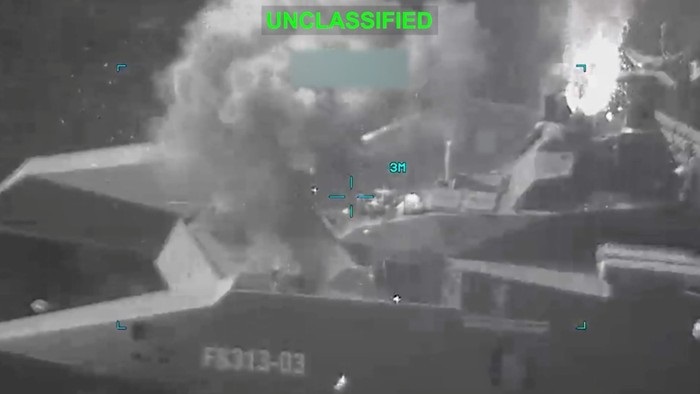
US Central Command (CENTCOM) images released on 4 March showed the Islamic Revolution Guards Corps Navy’s (IRGCN’s) Shahid Sayad Shirazi. The revelation and accompanying briefing detailed the rapid demise of Iran’s conventional naval power.
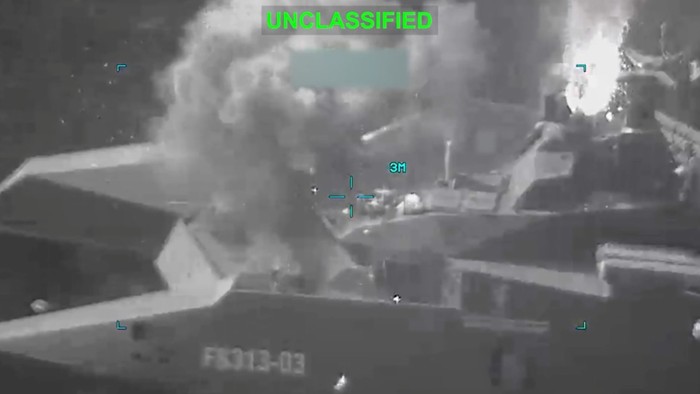
Image caption: An image released by US Central Command on 4 March shows the IRGCN’s Shahid Sayad Shirazi on fire.
Image credit: US Central Command
Officially commissioned in February 2024, Shahid Sayad Shirazi was the third of the Soleimani-class catamarans that represented the pinnacle of Iranian naval technology. Designed for high speed and a small radar cross-section, the 600 tonne vessels were armed with six anti-ship missiles, surface-to-air missiles in vertical launcher systems, and close-in weapon systems. Only two appear to have been fitted with air-surveillance radars by the beginning of the US-Israeli attack on 28 February.
US Secretary of Defense Peter Hegseth announced during a 4 March press briefing that the IRGCN’s “prize ship” Soleimani, the first of class, was sunk the previous evening. He also confirmed that Dena, the Islamic Republic of Iran Navy’s (IRIN’s) Jamaran-class frigate that attended India’s fleet review in February, had been sunk in the Indian Ocean by a US Navy submarine, adding that the Iranian navy was resting at the bottom of the Gulf.
Admiral Brad Cooper, the commander of CENTCOM, elaborated on the damage inflicted on Iran’s two navies after the first five days of Operation ‘Epic Fury’ in a press briefing on 5 March. He said that CENTCOM had “destroyed over 30 ships” as of the afternoon of 5 March EST.
“To hunt and kill an out-of-area deployer is something only the United States can do at this type of scale,” he said, regarding the sinking of Dena. “[We have] effectively neutralised at this point in time Iran’s major naval presence in theatre,” he added.

Image caption: An image from a video released online by CENTCOM on 6 March showing what it said was a strike on the Iranian UAV carrier Shahid Bahman Bagheri. Image credit: CENTCOM
CENTCOM said on social media platform X on 2 March that it had hit Iran’s unmanned aerial vehicle (UAV) carrier vessel, Shahid Bahman Bagheri (C110-4) within hours of launching ‘Epic Fury’ on 28 February. It did not say it had sunk the ship. On 5 March satellite imagery seen by Janes appeared to show Shahid Bahman Bagheri, possibly making way despite damage, in the Strait of Hormuz near Iran’s Bandar Abbas base. At around 17:15 EST in the 5 March briefing Adm Cooper said that US had hit “an Iranian drone carrier ship” and “as we speak, it’s on fire”. On 6 March CENTCOM releases a video on X showing what it said was a strike on the Shahid Bahman Bagheri.
The US military did not list the other ships sunk. However, satellite imagery shows that nearly all of the IRIN’s major surface combatants were docked in the Bandar Abbas and Konarak bases, and were heavily targeted at the outset of the war.
The IRIN’s primary surface combatants were seven Alvand/Jamaran-class frigates, four of were likely sunk or crippled as of 5 March. That left Alborz in a dry dock at Bandar Abbas and Deylaman in the Caspian sea. Both Bayandor-class corvettes were sunk at Konarak. Smaller missile-armed patrol vessels and support ships presumably make up most of the other vessels that have been sunk. Chairman of the Joint Chiefs of Staff General Dan Caine said during a briefing on 4 March that a submarine had been hit. This was probably the Kilo-class docked in Bandar Abbas at the outset of the conflict. This was likely Tareq (also spelt Taregh), with the IRIN’s other two Kilos undergoing extended refits.
For more, please see:
Analysis: IRGCN tests new weapons
IRGC Navy commissions fixed-wing UAV carrier
| The Iranian fleet was always likely to be easy to defeat in a high-intensity conflict, given the overwhelming air and naval power that the US could deploy. The IRGCN’s investment in larger vessels, which included two converted containers ships, one fitted with a flight deck for wheeled UAVs, looks questionable given this scenario. The force was arguably wasting resources as it intruded on the IRIN’s deep-water role. Instead, it could have focused on threatening shipping in the Gulf, Strait of Hormuz, and Gulf of Oman. The IRGCN’s ship-building programme might have reflected a mistaken belief it could fight a conventional naval war. If Iranian forces want to keep the Strait of Hormuz closed, they will very likely need to use missiles, one-way attack UAVs, and unmanned surface vessels (USVs) to help them do so. |